A PLUS KNOWLEDGE HUB · KH001
Why Localisation Is More Than Translation
Preserving Learning Across Languages, Cultures and Contexts
By Rachel Smith, Founder of A Plus Virtual Solutions · August 2026 · 10 min read
Localisation & Multilingual Learning
Introduction
You've spent months creating a course, training programme or educational resource.
It works. Learners understand it. The feedback is positive.
Now you want to make it available to a wider audience — perhaps in another language, another country or another culture.
Translation seems like the obvious next step.
But is translation always enough?
When we began researching localisation, we expected to explore a fairly straightforward question: what is the difference between translation and localisation?
The evidence led us to a more useful one:
How can organisations preserve learning while removing unnecessary barriers for people from different languages, cultures and contexts?
That distinction matters.
Translation makes knowledge accessible in another language.
Localisation builds on that foundation by considering whether factors such as examples, imagery, cultural references, accessibility or local context could affect how learners understand and apply that knowledge.¹²,¹³
The goal isn't to make every course culturally different.
It's to give learners an equivalent opportunity to achieve the intended learning outcomes.
What Is Localisation? Translation vs Localisation
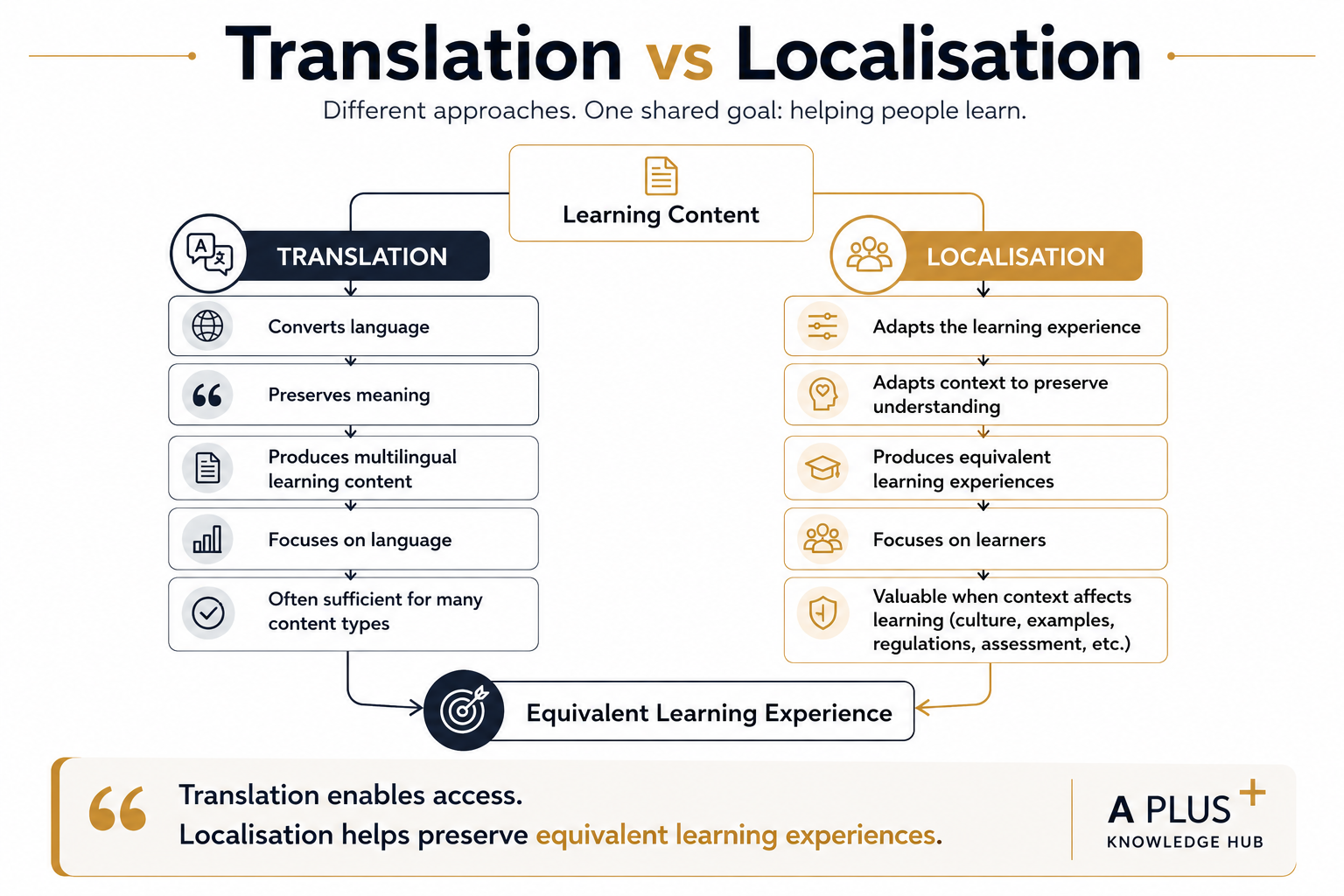
Translation and localisation are closely connected, but they solve different problems.
Translation accurately conveys meaning from one language to another. It is the foundation of multilingual communication and, in many situations, it may be all that's needed.³,⁶
Localisation builds on translation by considering how content will be experienced by a specific audience. Depending on the context, that might mean adapting examples, imagery, cultural references, measurements, accessibility features or other elements that influence understanding.¹²,¹³,¹⁶,¹⁷
The important distinction is the objective:
Translation asks: “Can learners access this content?”
Localisation asks: “Can learners in this context achieve the intended learning outcomes?”
Neither replaces the other. The right approach depends on the content, the audience and what learners need to achieve.
A simple example
Imagine a leadership course that uses baseball to explain teamwork.
The analogy may work perfectly for learners familiar with the sport. Translate it accurately for an audience unfamiliar with baseball, however, and every word could be correct while the example itself becomes less effective.
Localisation might replace it with a more familiar example while preserving exactly the same lesson.
The learning objective hasn't changed. The context has.
KEY INSIGHT
Translation makes knowledge accessible across languages.
Localisation builds on that foundation by helping learners achieve equivalent learning outcomes within their own language, culture and context. ¹² ¹³
When Is Translation Enough?
Not every course needs extensive localisation.
Sometimes, accurate, high-quality translation is exactly the right solution — particularly when the content is straightforward, the context is broadly transferable, and the main objective is to make information available in another language.
The question becomes more complicated when understanding depends on more than the words themselves.
Practical example
Consider a health and safety course based on UK workplace legislation. The course could be translated perfectly into Spanish, but that doesn't necessarily make it appropriate for learners in Spain or Latin America. The language may be accurate, while the legislation, procedures or workplace expectations are not.
The translation hasn't failed.
The learner hasn't failed.
The content simply contains barriers that translation alone cannot remove
Localisation becomes worth considering when elements such as these could affect the learning experience:
- Cultural references or unfamiliar examples
- Local laws, regulations or professional practices
- Images, symbols or scenarios whose meaning changes between audiences
- Measurements, currencies, dates or regional terminology
- Accessibility needs that affect how learners interact with the content
- Activities or assessments that assume particular cultural or contextual knowledge
The aim isn't to change content simply because learners live somewhere else.
It's to identify whether anything prevents them from understanding, engaging with or applying the intended learning.
A useful starting point is to ask what the learner needs to do with the content.
| Translation may be enough when… | Consider localisation when… |
|---|---|
| The main goal is straightforward information transfer | Learners need to apply knowledge or develop a skill |
| Examples and terminology transfer clearly between audiences | Examples depend heavily on culture or context |
| The content contains no market-specific requirements | Laws, regulations or professional practices vary by location |
| Existing visuals and activities remain meaningful | Visuals, scenarios or assessments may be interpreted differently |
And importantly, this doesn't have to be an all-or-nothing decision.
A course might need translation throughout but localisation only in selected places — perhaps one case study, an assessment, several images or a piece of region-specific guidance.
The right question isn't “translation or localisation?”
It's:
“What does this learner need in order to achieve the intended outcome?”
What the Evidence Shows
Our review of international standards, multilingual education guidance, accessibility research and industry practice pointed to five recurring themes:
Learning outcomes should come first.
Localisation decisions are strongest when they begin with what learners need to understand, remember or apply — not simply with what needs translating.
Context shapes understanding.
Culture, previous experience, local environment and expectations can all influence how examples, scenarios and instructions are interpreted.
Accessibility and localisation often support the same broader goal.
They address different barriers, but both aim to remove unnecessary obstacles without changing the intended learning objective.
Technology changes the workflow, not the purpose.
AI and digital tools can make multilingual content faster and more scalable, but they do not remove the need for human judgement about context, learning design and quality.
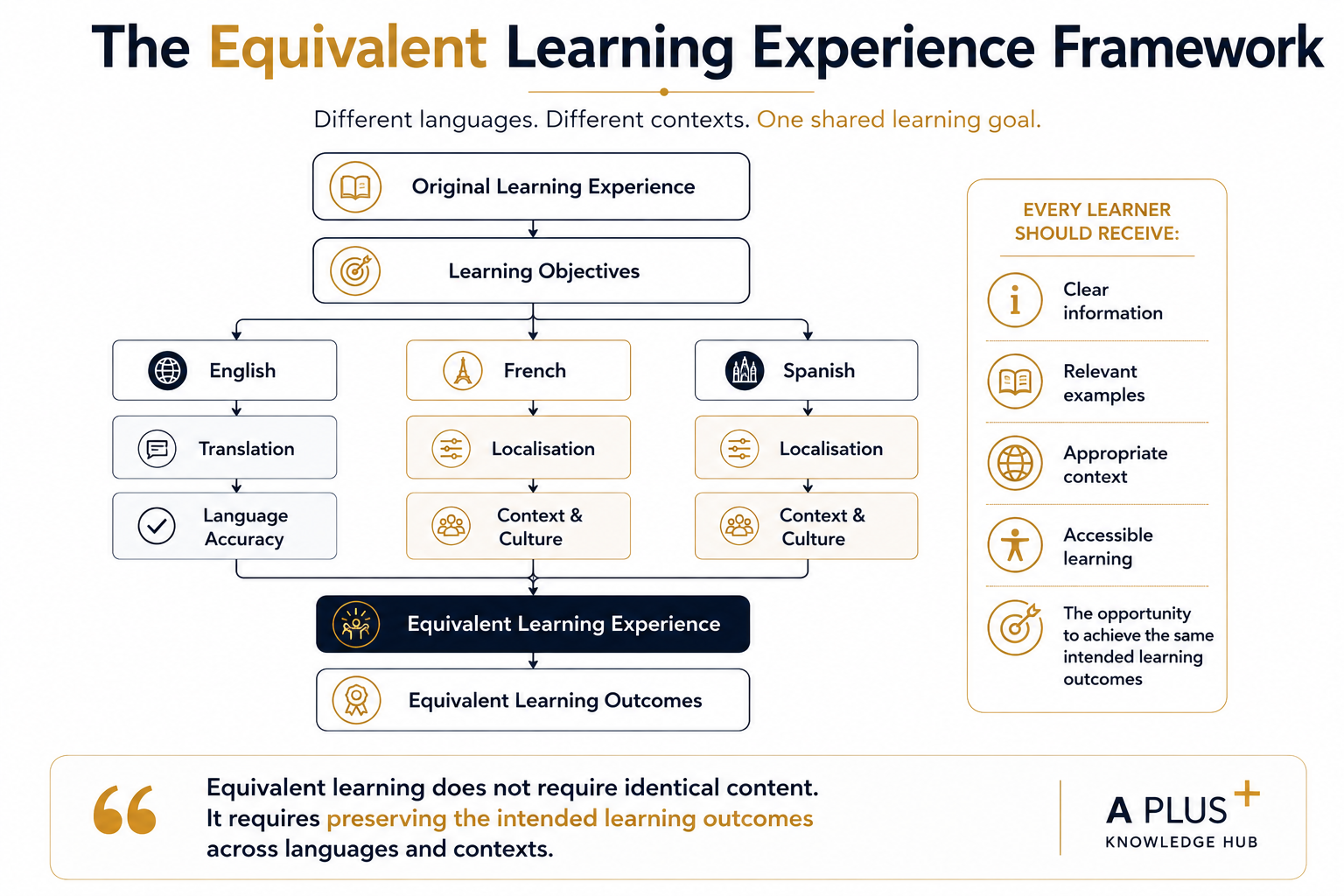
Equivalent learning does not require identical content.
Different audiences may need different examples, references or supporting materials to reach the same intended learning outcome.
The important point is not that every course needs extensive adaptation.
It is that linguistic accuracy is only one part of deciding whether a learning experience will work effectively in another context.
Across the sources reviewed for this article, five themes appeared consistently regardless of discipline or publication.
Preserving the Learning Experience
The goal of localisation isn't to make every version of a course identical.
It's to preserve what matters most: the opportunity for learners to achieve the same intended learning outcomes.
That distinction is important because equivalent learning experiences may look different across audiences.
An example that works perfectly in one culture might need replacing in another. A workplace scenario may need adapting to reflect local practices. An image, activity or assessment may need changing because it creates an unintended barrier.
Those adaptations don't necessarily change what is being taught.
They help preserve it.
Sources: ³,⁶,⁷,¹⁰,¹¹,¹²,¹³,¹⁴,¹⁵,¹⁶,¹⁷
A PLUS IN PRACTICE
While supporting the localisation of AI learning content across seven languages, one recurring question wasn't whether the translation was accurate.
It was whether learners in different countries would experience the same learning journey.
Examples, scenarios and references sometimes needed thoughtful adaptation—not because the translation was wrong, but because the goal was to preserve the learning experience rather than simply reproduce the original wording.
That experience reinforced one of the strongest conclusions from our research:
Successful localisation is about preserving learning, not simply reproducing language. ¹²,¹³
How to Decide Whether You Need Localisation
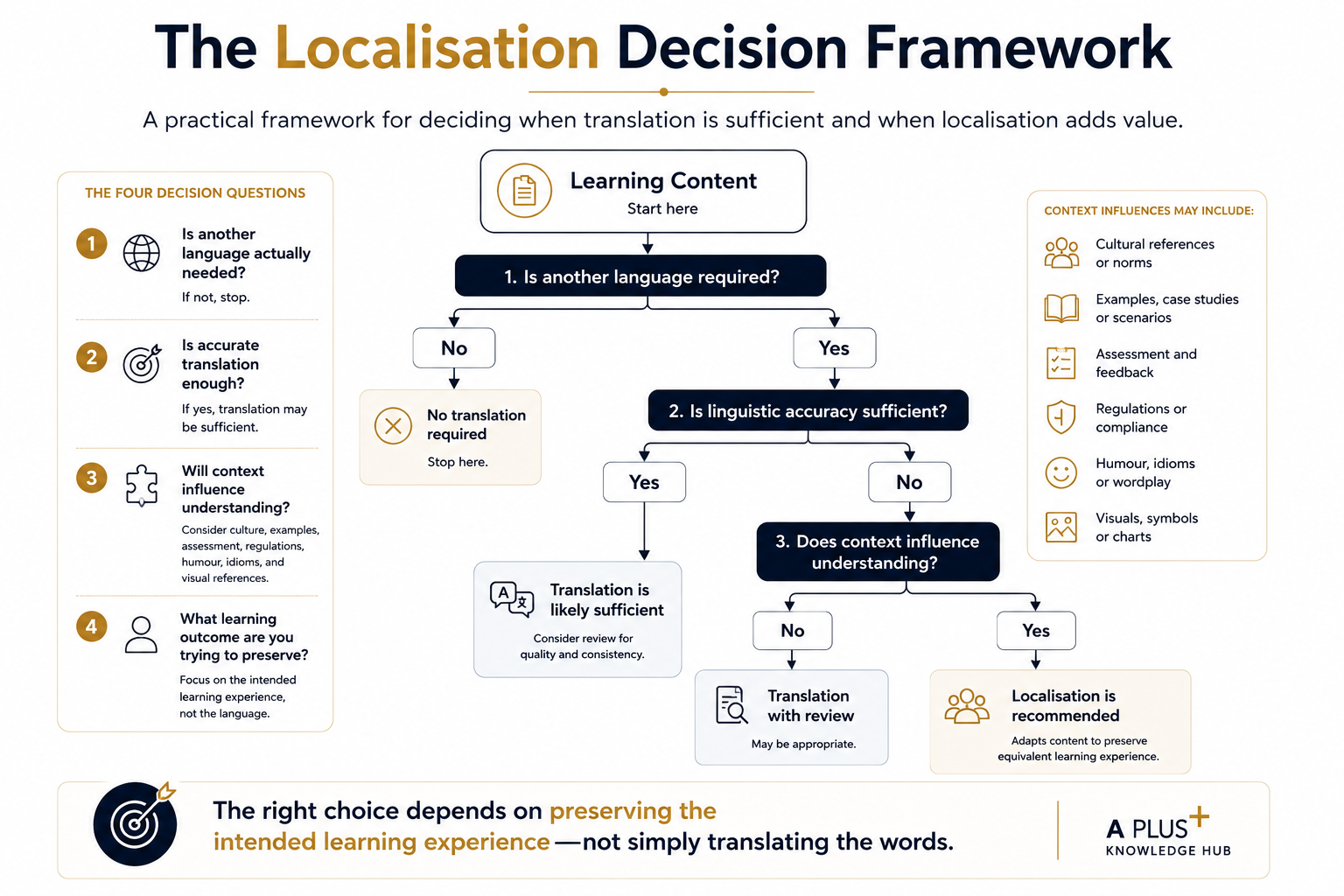
There isn't a universal rule for how much localisation a course needs.
A highly technical resource may transfer effectively with high-quality translation, while a short piece of training built around local legislation, humour or culturally specific scenarios may require considerably more adaptation.
The decision should start with the learner and the intended outcome, not with an assumption that everything needs to be localised.
A useful way to approach it is to assess where barriers could appear between the original content and the new audience.
 Sources: ⁶,¹²,¹³,¹⁵,¹⁶,¹⁷
Questions Worth Asking Before Starting
✓ Which parts of this content rely on cultural knowledge or assumptions?
✓ Could learners interpret examples differently in another country or culture?
✓ Does accessibility need to be considered alongside translation?
✓ Are we trying to make information available, or are we trying to maximise learning?
You don't necessarily need to choose between translating an entire course or completely rebuilding it for every market.
Often, the most effective approach is more targeted:
Translate what transfers. Localise what creates a barrier. Preserve what makes the learning effective.³,⁶
Why This Matters Now
AI is making multilingual content faster and more accessible to create.
Translation, transcription, subtitling and voice technologies can now help organisations reach international audiences at a speed and scale that would have been difficult or prohibitively expensive only a few years ago.
That creates enormous opportunity — but faster translation doesn't automatically create better learning.
As the technical barriers to multilingual content fall, organisations still need to ask:
Does this content simply need to exist in another language, or does something need to change for the learning to remain effective?
AI can support the process. Human judgement remains essential for understanding context, learning intent and the needs of the people the content is designed for.⁷,¹⁰,¹²,¹³
Why Preserving Learning Matters to Me
From Rachel Smith, Founder of A Plus Virtual Solutions
When I moved to France, I experienced firsthand how quickly language can become more than a communication challenge.
My psychology degree, knowledge and experience hadn't disappeared, but navigating a different education and professional system in a language I wasn't yet fluent in changed how easily I could use them.
For a long time, I wasn't sure what came next professionally.
That experience changed how I think about access to learning.
Later, while supporting the localisation of AI learning content across seven languages, I encountered the other side of the same challenge: the opportunity to help knowledge travel further without losing what made the learning valuable in the first place.
That's why I believe the most useful question isn't simply:
“Can we translate this?”
It's:
“How do we help this knowledge work for the people we're trying to reach?”
Translation may be the right answer.
Sometimes localisation will be needed too.
What matters is preserving the opportunity to learn.
Want to Explore the Research in More Depth?
This article is the concise web edition of KH001: Why Localisation Is More Than Translation, developed through the A Plus Research & Knowledge System (ARKS).
The full Research Edition explores the evidence in greater depth, including the research methodology, extended analysis, practical examples, original A Plus frameworks and a complete reference list.
PDF · 19 pages · Free to download
Not sure whether your course needs translation, localisation, or a mix of both?
About This Article
This article forms part of the A Plus Research & Knowledge System (ARKS) — our approach to combining structured research, recognised guidance and practical experience to explore the challenges organisations face when delivering learning across languages and cultures.
KH001 examines the difference between translation and localisation, and how organisations can preserve learning outcomes when adapting educational content for international audiences.
For the full methodology, extended analysis and supporting evidence, download the Full Research Edition above.
References
1. A Plus Virtual Solutions. (2026). ARKS Research Journal – RD001: Why Localisation Is More Than Translation (Internal research record).
3. European Commission. (n.d.). How to prepare.
10. Koot, D., & van der Meer, A.-M. (2025, March). TAUS quality estimation benchmarking report. TAUS.
11. UNESCO. (2015). Recommendation on adult learning and education.
12. UNESCO. (2025). Languages matter: Global guidance on multilingual education.
13. UNESCO International Bureau of Education. (n.d.). Contextualized curriculum.
14. World Wide Web Consortium. (2024, October 17). Internationalization glossary (W3C Group Note).
15. World Wide Web Consortium. (n.d.). Internationalization quick tips for the Web.
16.World Wide Web Consortium. (n.d.). Localization vs. internationalization.